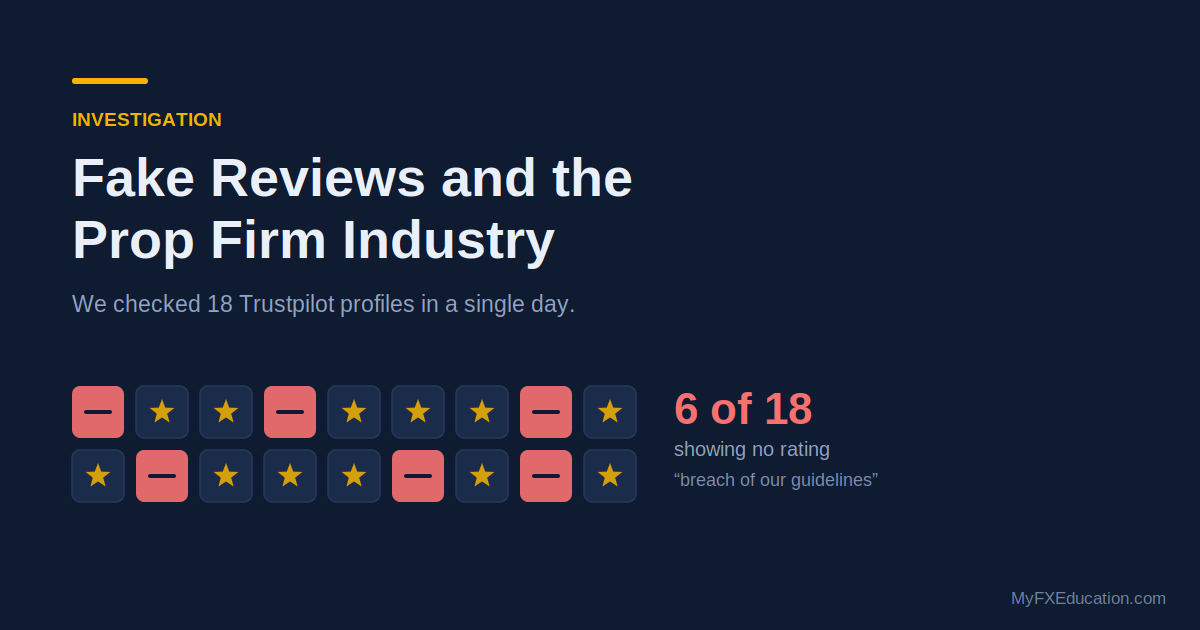
On 1 September 2026 we opened the Trustpilot profile of every prop firm we cover, plus every firm we had seriously considered covering, and wrote down what was on the page. Eighteen firms.
That is not a random sample and we are not going to pretend it is one. It is the set of firms that were already on our desk, which skews it toward firms big enough or noisy enough to be worth reviewing. Read the number below as a description of that set, not as an industry-wide rate.
Six of the eighteen were not showing a rating at all. In place of a score, each carried the same sentence:
“This company’s rating is unavailable due to a breach of our guidelines.”
Under it, in each case, a second line: “We’ve removed a number of fake reviews for this company.”
Six out of eighteen. Even allowing for how the set was picked, that is not a scattering of bad actors at the edge of an industry. In prop trading, a suppressed Trustpilot rating is common enough that you should treat checking for it as a routine step, the same way you would check whether a broker’s licence number actually appears on the regulator’s register.
This article is about what that banner means, what it very deliberately does not mean, and how to read a prop firm’s Trustpilot page yourself so you are not relying on us or anyone else.
What we found
Every profile below was retrieved on 1 September 2026. Review counts and star distributions move daily, so treat these as a snapshot with a date on it, not a permanent fact. Where a figure was not visible on the page we have said so rather than filled the gap.
Rating removed for a guidelines breach, 6 of 18 (retrieved 1 September 2026)
| Firm | Profile | Rating | Reviews | 5 star | 1 star |
|---|---|---|---|---|---|
| Alpha Capital Group | alphacapitalgroup.uk | Unavailable | 21,616 | 86% | 7% |
| Instant Funding | instantfunding.com | Unavailable | 4,375 | 61% | 27% |
| Goat Funded Trader | goatfundedtrader.com | Unavailable | 4,256 | 49% | 37% |
| E8 Markets | e8markets.com | Unavailable | 3,297 | 84% | 9% |
| Blue Guardian | blueguardian.com | Unavailable | 2,050 | 65% | 21% |
| BrightFunded | brightfunded.com | Unavailable | 560 | 73% | 18% |
The Blue Guardian profile currently displays under the name Guardian Markets.
Rating displayed, 12 of 18 (retrieved 1 September 2026)
| Firm | Profile | Rating | Reviews | Last 12 months |
|---|---|---|---|---|
| FTMO | ftmo.com | 4.8 | 50,796 | 24,561 |
| The5ers | the5ers.com | 4.7 | 36,457 | 19,480 |
| FundedNext | fundednext.com | 4.5 | 77,493 | 36,562 |
| FundingPips | fundingpips.com | 4.5 | 67,367 | 36,944 |
| Tradeify | tradeify.co | 4.5 | 4,186 | 3,408 |
| Hola Prime | holaprime.com | 4.5 | 3,477 | 3,201 |
| Moneta Funded | monetafunded.com | 4.5 | 53 | not shown |
| Lucid Trading | lucidtrading.com | 4.4 | 5,516 | 5,461 |
| Apex Trader Funding | apextraderfunding.com | 4.2 | 20,849 | 6,037 |
| City Traders Imperium | citytradersimperium.com | 4.2 | 1,623 | 258 |
| Topstep | topstep.com | 3.6 | 14,693 | 3,825 |
| The Funded Trader | thefundedtraderprogram.com | 2.9 | 21,945 | 211 |
Two things in that second table are worth pausing on, because they teach you more than the first table does.
The Funded Trader still has a rating. It is 2.9, it is bad, and it is visible. When we tried to load thefundedtraderprogram.com on 1 September 2026 the site returned an HTTP 402 response, and its profile shows 21,945 reviews in total against only 211 in the past twelve months. A visible rating is not a clean bill of health. Trustpilot’s enforcement is aimed at manipulation of the review platform, not at whether a business is any good or whether it is still functioning.
Topstep carries a banner too, but a different one. Its profile says: “You should know: This company may be associated with high-risk investments.” That is a consumer alert, not a guidelines-breach warning. It is informational, it applies across high-risk sectors, and it says nothing whatsoever about Topstep’s reviews. If you skim for “is there a box at the top of the page”, you will lump these together and get it badly wrong. Read the box.
What the banner actually means
Trustpilot publishes its enforcement policy, and it is more specific than most people assume.
There are two separate mechanisms.
A consumer alert is informational. Trustpilot applies it where there is something a consumer should know: a high-risk industry, significant media attention, a regulatory investigation. Trustpilot states plainly that an alert “does not necessarily mean the business has engaged in misuse or wrongdoing.” Topstep’s is one of these.
A consumer warning is an enforcement action for misuse of the platform by a business. The forms of misuse Trustpilot lists include fake reviews, biased review invitations, misuse of the flagging tool, brand misuse and unauthorised data scraping. While a consumer warning is active, the business’s TrustScore is hidden from view.
The part almost nobody knows is where a consumer warning sits in Trustpilot’s process. Trustpilot describes an escalating sequence: an educational email, then a warning, then a cease-and-desist notice, then account restrictions, then a consumer warning with TrustScore suspension, and beyond that legal proceedings or referral to law enforcement. A consumer warning is the fifth of six stages, not the first response. Separately, Trustpilot removes fake reviews from profiles constantly without any banner appearing at all.
Trustpilot does not publish which of those steps were applied to any individual business, and we are not going to guess.
Trustpilot says a consumer warning remains for a fixed time, “usually 6 months (but this can vary depending on the type of misuse).”
For scale: in 2024 Trustpilot removed 4.5 million reviews it assessed as fake, amounting to 7.4% of everything submitted that year, with about 90% of those caught automatically. It recorded around 9,000 consumer warnings active during 2024, across every industry on the platform. Trustpilot hosts many millions of business profiles, so warnings are rare in percentage terms across the platform as a whole. Six of them sitting on eighteen prop firms we happened to be looking at is a strikingly different picture, and it is the reason we wrote this.
What the banner does not mean, and we are going to be pedantic about this
The banner does not say who wrote the fake reviews. It does not say who paid for them. It does not say the firm commissioned them.
That distinction is not lawyerly hedging, it is the actual limit of what the evidence supports. Fake reviews land on a profile through several routes. A firm can buy them. An affiliate can buy them to make a firm they earn commission on look better. A review farm can seed profiles speculatively and sell the placement afterwards. A competitor can post fake negative reviews. Trustpilot does not publish the case file, so from the outside all you can see is the outcome.
So here is the precise claim, and the only one we will make:
Trustpilot concluded that these six businesses breached its guidelines, and has hidden their ratings as a result. That is a real and serious finding, made by the platform that holds the data. It is enough to make us decline to promote a firm. It is not a finding that any named firm wrote, bought or commissioned reviews, and we are not saying that about any of them.
If any of the six wants to put its side of this on the record, our contact page is open and we will publish the response in full.
The case that shows what suppression looks like from the outside
In March 2025, Hola Prime’s Trustpilot profile went from more than 1,300 reviews to 49 overnight, and its “Excellent” rating disappeared.
Finance Magnates reported the episode on 6 March 2025 and, notably, had identified the suspicious volume itself and notified Trustpilot. The detail that makes the story unambiguous is the dates. According to that report, Hola Prime launched around October or November 2024, yet reviews on its profile were dated as early as May 2024, months before it was selling challenges at all. One of them described completing a one-step challenge that was not on sale yet.
Finance Magnates reported that its questions to Hola Prime went unanswered.
Today that profile is clean: 4.5 across 3,477 reviews, no banner, and a normal daily flow of new reviews. The profile has rebuilt from 49 to 3,477 since the removal. That is what makes Hola Prime the most useful case in this article, because it shows both halves of the mechanism. A suppression is not a life sentence. A clean profile today tells you nothing about a profile eighteen months ago.
We publish a full review of Hola Prime, and it says all of this in it. We would rather send you to a firm with a documented past you can weigh than pretend the past is not there.
The case we had to date ourselves
Alpha Capital Group is the largest firm in the flagged group by a distance, with 21,616 reviews on its profile. Its own website names its operating entity as Alpha Capital Group Limited, UK company number 13719951, with a registered office in Harpenden. Companies House shows a company of that name and number, incorporated 2 November 2021, currently active.
We wanted to know when its rating was suppressed. No trade outlet appears to have reported it, and Trustpilot does not date the banner.
So we went to the Internet Archive. The Wayback Machine holds a capture of the profile taken on 30 January 2026 at 21:32 UTC. That snapshot shows a live TrustScore of 4.7 across 16,379 reviews, a distribution of 86 / 5 / 1 / under 1 / 7, a claimed profile with a paid Trustpilot subscription, a note that the company had “Replied to 80% of negative reviews”, and no guidelines-breach banner of any kind.
When we checked the live profile on 31 August 2026, and again on 1 September 2026, the banner was there.
So the suppression landed somewhere between 30 January and 31 August 2026. We are stating that as a range because a range is what the evidence gives us: the Wayback Machine appears to hold no capture of that URL between those two dates, so we cannot narrow it further. The snapshot is public and you can check it yourself at web.archive.org/web/20260130213231/https://www.trustpilot.com/review/alphacapitalgroup.uk. If anyone can narrow the window with an intermediate capture, send it to us and we will update this article and credit you.
We do not carry an affiliate link to Alpha Capital Group and we do not intend to while that banner stands. On pure commercial logic it is the single most attractive firm in this article to promote. That is rather the point.
Why this industry in particular
Three things about prop firms make their review profiles unusually easy to distort.
The product creates two populations and almost nothing in between. A trader either passes an evaluation and gets paid, or breaches a rule and loses a fee. Delight and fury, with very few people mildly satisfied. Look at the distributions above: Alpha Capital Group’s profile runs 86% five star and 7% one star, leaving only 7% spread across two, three and four stars combined. A barbell shape in this sector is normal and is not by itself evidence of anything. It does mean a manufactured cluster of five star reviews hides more easily here than it would in a sector with a normal spread.
Review volume is bought with prompting, not earned with quality. A firm that emails every customer at the right moment collects vastly more reviews than one that does not. That is entirely legitimate, and both large and small firms do it. It does mean review count measures marketing effort at least as much as it measures satisfaction.
The surrounding review ecosystem is affiliate-funded almost end to end. Most “best prop firm” lists you will find are monetised with discount codes. Prop Firm Match, the most complete third-party payout tracker in the sector, states that it sources payout data directly from the firms themselves, and its firm profile pages carry discount codes. We use it, because it is the best available, and we tell you what it is. Very few sites do.
Add those together and social proof becomes the main battleground, in a sector selling a product where the buyer usually loses their fee.
How to read a prop firm’s Trustpilot page yourself
This takes about four minutes and is worth more than any list we could write.
- Look at the top of the page first, and read which box it is. A guidelines-breach warning and a high-risk-investment alert are completely different things.
- Compare total reviews with the last twelve months. A firm with 20,000 reviews and 200 in the past year is not the firm those 20,000 reviews described. That gap is where a failing business hides.
- Check the claimed date. A profile claimed years ago with steady flow since is a different proposition from one claimed three months ago that already has thousands of reviews.
- Look at the shape, not just the score. A barbell is normal here. What is odd is a very large profile with almost no one-star reviews at all.
- Sort by most recent and scroll. You are looking for bursts: twenty short, generic, five-star reviews in one day, then nothing for a week.
- Read the one-star reviews for a mechanism, not for anger. “Scam, avoid” tells you nothing. “They voided my payout under the consistency rule after approving it” tells you which clause to go and read in the terms.
- Check whether the firm replies to negative reviews, and how. The replies are more revealing than the reviews. When we checked on 31 August 2026, Tradeify’s profile reported replies to 96% of negative reviews. Lucid Trading’s reported 1%.
- Check the review dates against the firm’s launch. It sounds absurd until you remember that this is exactly how the Hola Prime episode surfaced.
- Be wary if a firm offers you a discount, a free reset or account credit in exchange for a review. Trustpilot’s guidelines prohibit businesses from offering incentives for reviews. Under the FTC’s rule in the US, conditioning any payment or incentive on a review expressing a particular sentiment is banned outright. You are being asked to take part in something the firm should not be doing.
The law caught up in 2024 and 2025
Fake reviews stopped being merely against a platform’s terms fairly recently.
In the United States, the FTC’s Rule on the Use of Consumer Reviews and Testimonials took effect on 21 October 2024. It bans creating, buying or selling fake reviews, conditioning compensation on a review expressing a particular sentiment, undisclosed insider reviews, misrepresenting a company-controlled site as independent, suppressing negative reviews through threats or false claims, and buying fake followers or engagement. The rule allows courts to impose civil penalties for knowing violations.
In the United Kingdom, the Digital Markets, Competition and Consumers Act brought its unfair commercial practices provisions into force on 6 April 2025, making the submitting, commissioning or facilitating of fake or misleading reviews a banned practice, and giving the CMA power to fine businesses directly up to 10% of worldwide annual turnover without first going to court.
Prop firms are globally distributed and often incorporated somewhere convenient, so enforcement against them is a genuinely open question. But the position that manufactured social proof is a compliance problem rather than sharp marketing is now settled in both jurisdictions.
What we do about it here
We say we do not do paid reviews. Here is what that costs us, specifically.
- We do not carry an affiliate link to any firm while a Trustpilot guidelines-breach warning or an active regulator warning stands against it. On the Trustpilot ground that currently rules out E8 Markets and Alpha Capital Group, the only two of the six flagged firms we actually cover. On the regulator ground it rules out VT Markets and PU Prime, both of which appear on the FCA’s warning list of firms operating without authorisation in the UK. We review all four anyway. An FCA warning-list entry is a notice that a firm is not authorised here. It is not a fine, a finding of wrongdoing or an enforcement action, and we do not present it as one.
- Where we have not monetised a review, the review says so on the page. Which means we cannot quietly add a link later without first rewriting the copy to stop it being a lie.
- We do carry affiliate links elsewhere on this site to some firms named in this article, including FundingPips, Tradeify and Hola Prime. You should factor that in when reading us. It is exactly why the whole method above is written out, so you can go and check rather than take our word for it. This article itself carries no affiliate links at all.
- We do not describe self-reported payout totals as verified. Nobody audits them. Hola Prime, for example, has had its cumulative payouts reported three different ways through three firm-connected channels, at roughly $3.2m, $7m and $10.03m. We print all three and tell you they cannot all be right.
Method and limits
We retrieved each profile once on 1 September 2026 and recorded what was displayed. Two profiles, Instant Funding and Moneta Funded, would not serve to us on trustpilot.com and were read on Trustpilot’s Canadian domain instead. The Moneta Funded profile returned only partial data and we have marked the missing fields rather than estimating them. Its 53 reviews are far too few to draw anything from either way.
The eighteen firms are the ones we cover or considered covering. It is a convenience sample, not a survey.
We did not attempt to determine who wrote or procured any review on any profile. We are not in a position to and neither is anyone else outside Trustpilot.
Review counts, ratings and banners change. Trustpilot says a consumer warning usually runs about six months, so some of the six firms above will very likely be showing a rating again by the time you read this. That will not mean the episode did not happen, and it will not mean it did. Go and look at the page yourself. That was the whole point of the checklist.
Last checked: 1 September 2026. If you spot something on one of these profiles that contradicts what we have written, tell us and we will correct it with a dated note.
Our full review method, including the factors we score and every firm we have chosen not to monetise, is on our review methodology page.