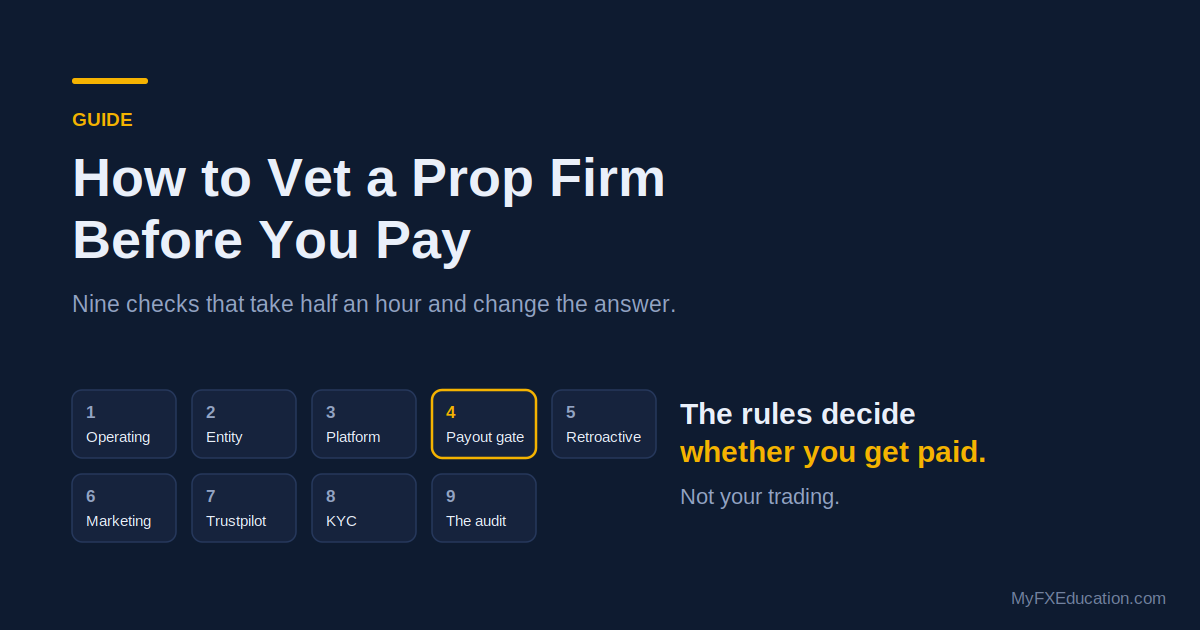
Most people choosing a prop firm compare the same three numbers: the profit split, the account size, and the fee. Those are the three numbers the firm puts on the landing page, which is a reasonable clue that they are not the numbers that decide anything.
What decides whether you ever see money is the rulebook. Not your trading. The rulebook determines whether a profitable account converts into a payment, and in this industry it is entirely normal for a trader to hit the target, break no rule they were aware of, and still not get paid.
We have now reviewed thirteen prop firms in detail. This is the check we run before we write a word, in the order we run it. It takes about half an hour and it has repeatedly changed our answer.
1. Confirm the firm is actually operating and paying
Start here, because nothing else matters if the answer is no, and because the answer is not always obvious from the website.
Prop firms rarely announce that they have stopped. They go quiet. The checkout keeps working. The Discord stays up. What changes is that payouts slow, then stop, then get replaced by settlement offers.
Three quick signals:
Does the site actually load? When we checked The Funded Trader on 1 September 2026, thefundedtraderprogram.com returned an HTTP 402 response rather than a page. A firm whose own website is not serving is not a firm you should be paying.
Look at recent review volume, not the rating. The Funded Trader’s Trustpilot profile shows 21,945 reviews lifetime and 211 in the past twelve months. That collapse is the shape of a business that has stopped acquiring customers. It is far more informative than the score.
Check whether the platform provider is still there. SurgeTrader stopped operating in May 2024 when Match-Trade withdrew its platform licence. The firm did not fail because it ran out of money in any visible way. It lost the thing it needed to function. Its domain now redirects to a for-sale page.
Also worth knowing: not every closure is a scandal. MyFundedFX, later Seacrest Funded, discontinued prop operations on 6 February 2026 in an orderly wind-down with refunds and a claims deadline. That is a very different event from a firm going silent while owing people money, and the two deserve different words.
2. Find out who you are actually contracting with
Scroll to the footer and read the legal entity. Then ask three questions.
Is there a company number, and does it resolve? A named company with a registration number you can look up is the minimum. Several firms disclose nothing at all.
Is the address a real place of business or a registered-agent address? One firm we researched lists 3500 S Dupont Hwy, Dover, Delaware, an address shared by very large numbers of entities. That tells you the state of incorporation and nothing whatsoever about where the business is, who runs it, or what recourse you have.
Is anyone named? Some of the largest firms in this sector disclose no founder, no CEO and no executive anywhere on the site. That is not automatically disqualifying, but it should change what you are willing to risk, and it is worth noticing that the firms with the most to lose reputationally are usually the ones willing to put names to it.
For futures firms specifically, there is a much harder test available: who clears the trades? Tradeify names NinjaTrader Clearing LLC as its FCM and publishes an NFA ID. That is a checkable, third-party-verifiable fact about how the business is plumbed. A futures firm that will not name its clearing arrangement is telling you something.
One more thing, and it explains a lot of what you will see: prop firms have been migrating their licensing to Mauritius through 2025 and 2026, following earlier moves to the Comoros, largely as a response to platform restrictions. A Mauritius licence is real, and it is also a sector-wide manoeuvre rather than a mark of unusual rigour. Read it as context, not as a seal.
3. Ask who owns the platform licence
This is the least discussed and most consequential structural risk in prop trading, and it killed at least one firm outright.
Most firms do not own their platform relationship. They access MetaTrader or a similar platform through a licence that can be withdrawn. When MetaQuotes tightened its position on prop firms in early 2024, firms lost access more or less overnight.
Funding Pips was cut off in February 2024 and responded by obtaining its own direct MT5 licence in March 2025. That is the single most expensive and least glamorous thing a prop firm can do, and it removes precisely the dependency that ended SurgeTrader.
You will not find this on a comparison table. You usually have to look for an announcement or ask support directly. It is worth the email.
4. Read the payout gate, not the profit split
The headline split is close to meaningless on its own, because in most rulebooks it is conditional.
Some real structures we have documented:
The split can be a function of how often you withdraw. Funding Pips pays 60% on weekly withdrawals, 80% bi-weekly, 90% on demand and 100% monthly, with a 35% consistency requirement attached to the two highest tiers. The “100%” is real. It is also the slowest and most constrained option.
“No consistency rule” can be true in the challenge and false at payout. E8 Markets markets an absence of a consistency rule, and applies a Best Day gate at the payout stage instead: 40% on one product, 35% on another. The constraint has not been removed, it has been relocated to the point where money leaves.
There can be a cap on how many payouts you ever get. One product we reviewed limits an account to five payouts in a cycle with per-payout caps of $3,000 to $7,000. Another has a five-payout lifetime cap that does not appear in the marketing at all.
So the question is not “what is the split”. It is: how much money can leave this account, how often, and what has to be true each time? Work that out in pounds before you pay anything.
5. Hunt for the retroactive clauses
This is where the real damage happens, and it takes about ten minutes.
Search the terms and the trading rules for “at any time”, “sole discretion”, “effective immediately” and “retroactive”. You are looking for two specific things.
Can the rules change under an account you already own? Almost every firm reserves the right to change rules at will. What separates them is whether existing accounts are protected. Tradeify cut contract limits on 12 September 2025 and its help centre still preserves the pre-change figures for accounts purchased before that date. That is grandfathering, and it is the behaviour you want. Other firms reserve the right to change trading rules “at any time, with any changes becoming effective as soon as they are posted”, with notification of significant changes only at their discretion, and we have found no evidence of grandfathering.
Can profit already earned be taken back? Some rulebooks allow profits to be reversed retroactively if a concentration or speculative-trading threshold is breached, meaning a trade you closed weeks ago can be reclassified and removed from your balance. Hola Prime operates a 60% concentration rule of this kind. If a firm can retroactively unmake your profit, your equity curve is a proposal, not a fact.
While you are in there, check the liability cap. One firm we reviewed caps its total liability at the greater of the previous month’s fees or $100.
6. Read the marketing against the rulebook
Open the sales page and the rules page side by side. Contradictions between them are one of the most reliable red flags available to you, because they are cheap to find and hard to explain away.
On one firm we reviewed, the marketing and the rules disagree about news trading and weekend holding; the scaling page says maximum capital is $4m while the terms say $2m; and the rules page states a 25% consistency threshold while the terms state 20% to 40%.
Any one of those could be a stale page. All of them together tells you the firm does not have a single authoritative version of its own rules, which is a problem for you specifically, because you will be held to whichever version is least convenient.
Also check whether the terms are current at all. One firm’s governing terms were more than seventeen months old when we read them and contradicted the live product on profit split, fee model and geography.
7. Do the Trustpilot check properly
We checked eighteen prop firm profiles on a single day in September 2026. Six were showing no rating at all, replaced by “This company’s rating is unavailable due to a breach of our guidelines”.
Two things to get right. First, that guidelines-breach warning is not the same as the “may be associated with high-risk investments” notice, which is informational and appears across the sector. Read which box you are looking at. Second, a visible rating is not a clean bill of health, and a suppressed one does not tell you who wrote the fake reviews.
We wrote the whole method up separately, including what the banner does and does not prove. It is the most useful four minutes you can spend on a firm.
8. Ask when KYC happens
If identity verification only happens at the point of your first withdrawal, then every identity problem surfaces at the exact moment you are owed money, which is the worst possible time to discover a document mismatch. Several firms work this way and it generates a predictable stream of complaints about rejected withdrawals.
Ask before you buy. A firm that verifies you up front has removed a category of dispute for both of you.
9. If there is an audit, read what was actually audited
Third-party audits are becoming a marketing feature in this sector, and the gap between what people assume was audited and what was audited is wide.
Hola Prime commissioned Deloitte to audit its payouts. What Deloitte examined was payout speed over a defined window, 15 October 2025 to 15 March 2026, reporting 98.35% processed within an hour and no denials. That is a genuinely useful and unusually transparent thing to have done. It is not an audit of how much the firm has paid out in total, and it is not an audit of the firm’s solvency.
Which matters, because that same firm’s cumulative payout total has been reported three different ways through three firm-connected channels, at roughly $3.2m, $7m and $10.03m. Those cannot all be right, and no audit addresses them.
More generally: treat every payout total in this industry as self-reported. The most complete third-party tracker sources its figures directly from the firms and is itself affiliate-monetised. Two of the largest firms do not participate at all, so their absence from the table means nothing.
The ten-minute version
If you do nothing else:
- Load the site. Does it serve?
- Trustpilot: check the banner type, then compare lifetime reviews against the last twelve months.
- Footer: company number, real address, named people.
- Futures only: who is the FCM?
- Search the terms for “at any time”, “sole discretion”, “retroactive”.
- Find every cap: per payout, per cycle, lifetime.
- Work out the split at the withdrawal frequency you would actually use.
- Open the sales page and the rules page together and look for disagreements.
- Ask support when KYC happens.
- Read the last date the terms were updated.
What good actually looks like
It is worth saying what a firm doing this properly looks like, because the list above can read as though nobody passes.
The best-documented firm we found published its full price list, named its clearing firm and regulator ID, dated a rule change, preserved the old figures for existing accounts, and replied to 96% of its negative reviews. None of that required it to be generous. It required it to be legible.
That is the standard. Not “is this firm nice”, but can I tell what I am agreeing to, and will it still mean the same thing next month?
And the part nobody wants to hear
The challenge fee is at risk. Most people who buy an evaluation never reach a payout, and that is true at the well-run firms too. Prop accounts are simulated evaluation environments and a contractual profit share, not your own capital in a live brokerage account.
None of the checks above will make you profitable. What they will do is stop you losing a fee to a firm that was never going to pay you, which is a smaller and much more achievable goal.
Do the half hour. Read the terms before you pay, not after something goes wrong.
Every firm named here is covered in our prop firm reviews, including the ones we do not earn anything from. Our full method, and the list of firms we have chosen not to monetise, is on the review methodology page.
Trader Takeaway
A prop challenge should be treated like an operational ruleset, not as a shortcut to guaranteed returns or easier trading.