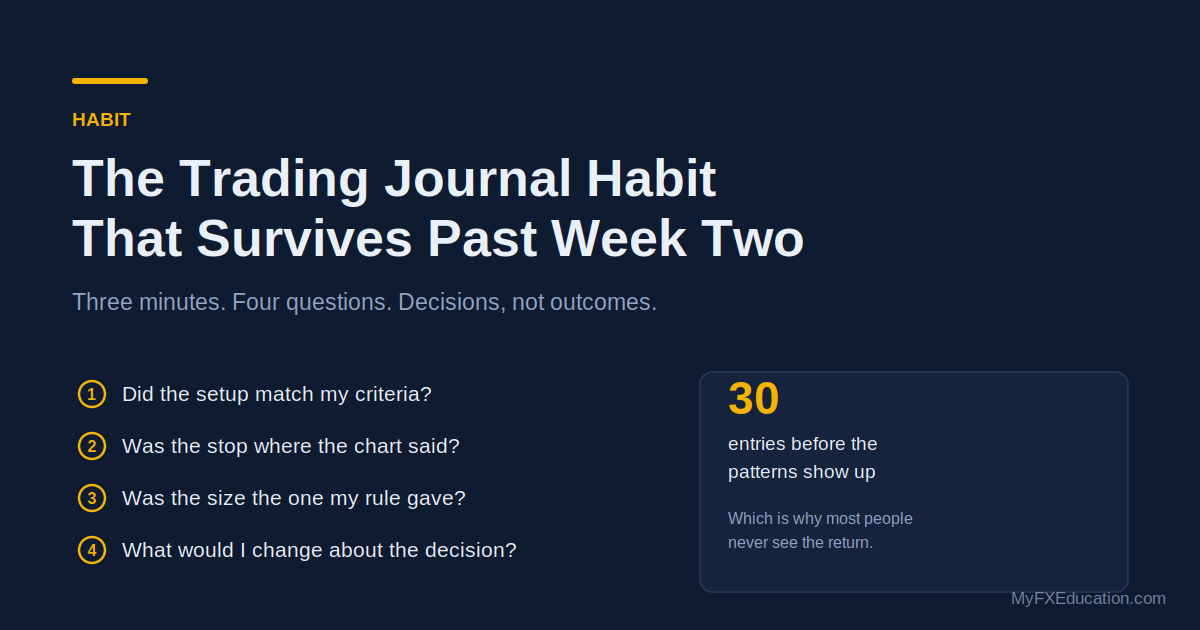
Trade journaling is the most recommended habit in trading education and one of the most abandoned. Most people start one, keep it for eleven days, and quietly stop.
The advice is not wrong. The habit is genuinely valuable. What is usually wrong is the design: the journal is built to be thorough rather than built to survive, and thoroughness loses to Tuesday evening every time.
Why journals get abandoned
They are too big. A template with twenty-two fields per trade is a template you will fill in properly for a week. A journal that takes six minutes per trade will not be kept by someone taking four trades a day.
They record the wrong thing. Most abandoned journals are outcome logs: entry, exit, profit, loss. That data is already in your broker statement. Copying it out by hand feels like work without producing any insight, and habits that produce no visible return get dropped.
They are reviewed too late to matter. A journal reviewed monthly is a filing exercise. The value comes from noticing a pattern while you can still do something about it.
The version that survives
Three minutes, immediately after the trade closes. Not at the end of the day, not at the weekend. Immediately, while you can still remember what you were thinking, because what you were thinking is the entire point.
Four questions, not twenty-two fields:
- Did this setup match my criteria before I entered, yes or no?
- Was the stop at a level the chart justified, or a level I was comfortable with?
- Was the position size the one my rule gave me, or a different one?
- What would I change about the decision, ignoring how it turned out?
That is it. Four answers, most of them one word.
Record the decision, not the result. This is the single most important distinction and it is what separates a journal that improves you from a journal that just annoys you. A good trade that lost money is a good trade. A bad trade that made money is a bad trade, and it is more dangerous, because it teaches you the wrong lesson with a reward attached.
If you only log outcomes you will learn to repeat whatever happened to work recently. That is not a strategy, it is a superstition.
What appears after thirty trades
Nothing useful appears after five. The habit only starts paying at around thirty entries, which is why so few people ever see the return on it.
What emerges then is not a market insight. It is a behavioural one, and it is almost always some version of:
- The setups you take that are not actually in your plan, and how they perform
- The stops you move, and in which direction, and after how long
- The sizes you increase, and what was happening just before
- The time of day, or the day of the week, where your discipline slips
None of that is available from a broker statement. All of it is actionable, and most of it is fixable by a rule rather than by more effort.
The one column most people leave out
Add a column for the position size your rule said you should take, next to the size you actually took.
It sounds trivial. It is usually the most uncomfortable and most valuable thing in the whole document, because sizing drift is invisible trade by trade and obvious across thirty.
Making it stick
Attach it to something you already do. The journal entry happens when you close the position, not as a separate task requiring separate motivation.
Keep it in one place, and make that place fast. A spreadsheet you can open in two seconds beats a beautiful app you have to log into.
Accept gaps. A journal with holes in it is still enormously more useful than no journal. People abandon the habit because they missed three days and it felt ruined. It is not ruined, it is a journal with three days missing.
Review weekly for five minutes, monthly for twenty. The weekly review is for catching a drift while it is still small. The monthly one is for the patterns.
The summary
Start smaller than you think you should. Record decisions rather than outcomes. Review the process, not the profit and loss.
The habit compounds much faster than the content does, and a rough journal you actually keep is worth more than a perfect one you kept in March.
Where to go next
What to record in more detail, and what to leave out, is covered in our lesson on the forex trading journal. The sizing column mentioned above connects directly to position sizing, and if reviewing your losing runs is the part you find hardest, drawdown and losing streaks puts numbers on why they feel worse than they are.
Trader Takeaway
A review habit does not need to be complex. A few consistent questions answered honestly after every trade will outperform sophisticated journals left empty.