Almost everyone who trades for more than a few months knows how to calculate a position size. The formula is not hard, it takes ten seconds, and there is a calculator on this site that will do it for you.
And yet inconsistent sizing is one of the most reliable ways retail accounts die. Not ignorance of the formula. Abandonment of it.
That gap between knowing and doing is worth more attention than the arithmetic, because the arithmetic is not where accounts are lost.
The four ways people stop sizing consistently
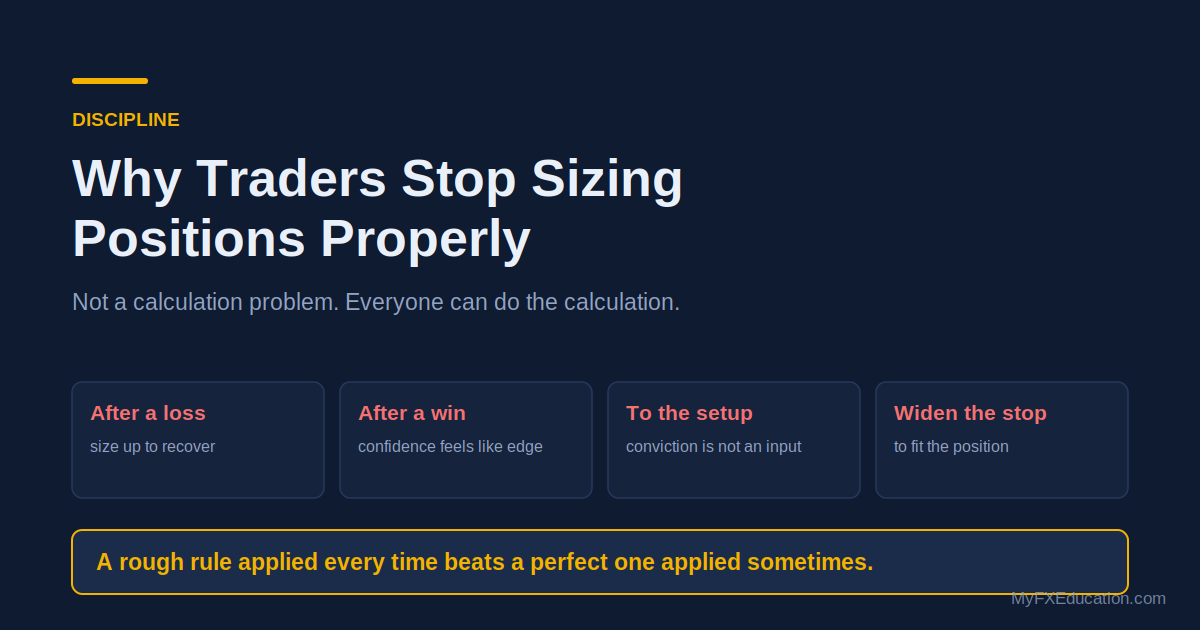
Sizing up after a loss. The account is down and the instinct is to make it back in one trade rather than five. This is the most destructive of the four because it increases exposure at precisely the moment your judgement is most compromised, and it turns a normal losing run into a serious drawdown. The arithmetic of why that matters is unforgiving: a 20% loss needs a 25% gain to recover, a 50% loss needs 100%.
Sizing up after a win. Less obviously dangerous and almost as costly. Confidence after a good run feels like information, but a sequence of wins tells you very little about the next trade. What it reliably does is make a larger position feel reasonable, which means your biggest position arrives just as your edge is most likely to be mean-reverting.
Sizing to the setup rather than to the stop. “This one looks really good” is not a risk input. If conviction changes your size, then your worst trades and your best trades have different weights in your results, and you can no longer tell whether your edge is real or whether you got lucky on the big ones.
Widening the stop to fit the position. The subtlest one. You want a certain position size, the honest stop makes it too small to be interesting, so the stop moves instead. This inverts the entire logic: the stop is supposed to be where you are wrong, and the position is supposed to be whatever that distance allows.
Why consistency beats precision
Here is the part that is genuinely counterintuitive.
A trader who applies a rough 1% rule imperfectly will almost always finish ahead of a trader who calculates to the decimal but varies exposure based on how they feel. The first trader’s results are a readable test of their strategy. The second trader’s results are a test of their mood, and moods do not have an edge.
Consistent sizing does two things at once. It caps the damage from any single decision, and it makes your track record mean something. Thirty trades at the same risk tells you whether your approach works. Thirty trades at wildly varying risk tells you almost nothing, because the outcome is dominated by which trades happened to be large.
What to actually do
Decide the rule once, away from the screen. One percent of the account per trade is the common starting point, and it exists because it survives a long losing run. At 1%, ten losses in a row costs about a tenth of the account. At 5%, the same run costs about 40%.
Calculate before entry, every time, including the trades you are sure about. Especially those.
Track adherence, not just outcome. In your journal, record the size you should have taken alongside the size you did. After thirty trades the pattern is visible and it is usually uncomfortable. That single column has changed more trading behaviour than any amount of strategy work.
If the honest position is too small to be interesting, the problem is the account, not the stop. Trade it anyway at the correct size, or do not trade it. Making the position bigger than the risk allows does not make the opportunity better, it makes the loss bigger.
The uncomfortable summary
Position sizing is not a calculation problem. Everyone reading this can do the calculation.
It is a compliance problem, and the person you are failing to comply with is yourself, at a moment when you have a good reason that will not look good written down. Which is the argument for writing it down.
Where to go next
The calculation itself, with worked examples, is in our lesson on position sizing. If you want the numbers on how much to risk in the first place, how much to risk per trade covers why one to two percent is the usual answer. The position size calculator will do the arithmetic in a few seconds, and drawdown and losing streaks explains why the recovery maths punishes big losses so heavily.
Trader Takeaway
Position sizing is not about finding a magic number. It is about applying a consistent rule before every trade so risk stays predictable.