Most people meet the economic calendar as a list of flags and clocks, decide it looks like homework, and close it. Then they get stopped out at half past one on a Wednesday and go looking for what happened.
The calendar is not homework and it is not a signal generator. It is the one place that tells you, in advance, when the market is likely to stop behaving normally. Used properly it changes almost nothing about what you trade and quite a lot about when and how much.
What the calendar actually is
It is a schedule of data releases and central bank events, published ahead of time, with three things attached to each entry: the expected number, the previous number, and an impact rating.
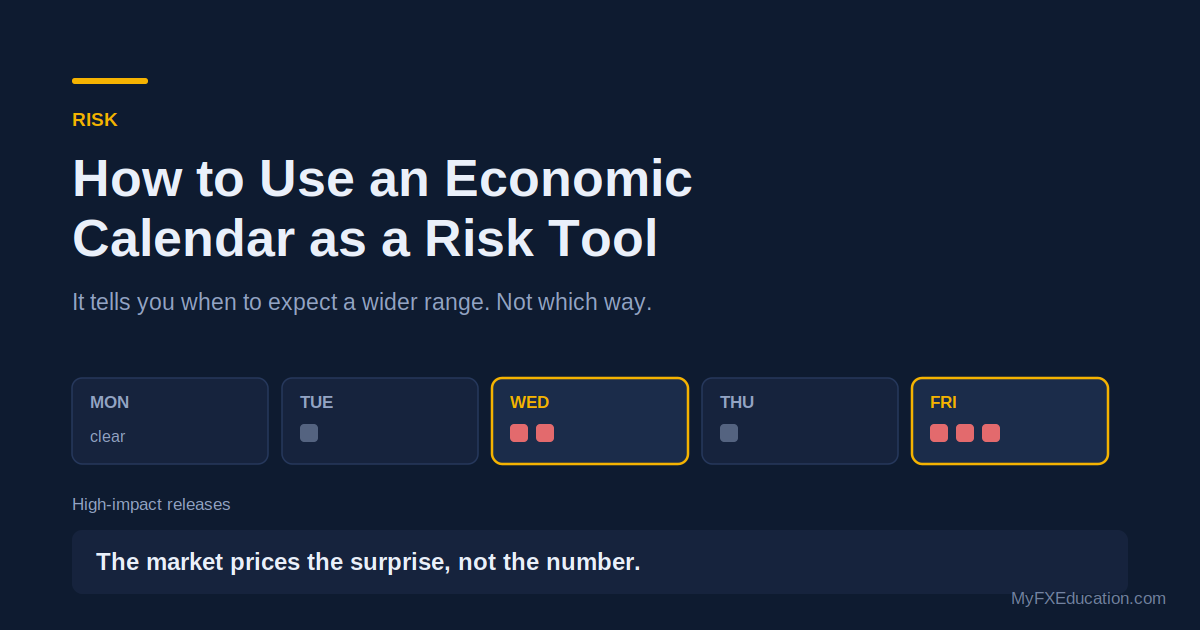
That last one is the part people misread. A high-impact tag is not a forecast that the market will move. It is a note that this release has historically produced sharp or sustained moves, so the range of outcomes is wider than usual. It is a volatility warning, not a direction.
The three events that matter most
For the major currencies, the releases that most reliably widen the range are:
Central bank rate decisions, and more importantly the statement and press conference that follow. The rate itself is usually priced in. The language about what happens next is not.
Inflation data, typically CPI. This is what central banks are reacting to, so it moves expectations about the next decision rather than the current one.
Employment data, most famously US Non-Farm Payrolls on the first Friday of the month. High volume, wide spreads, and frequently a first move that reverses within minutes.
Everything else is context. If you are trading a major pair and you know where those three sit in the week, you have most of the value the calendar offers.
The mistake that costs people money
The intuitive use of a calendar is to predict. Inflation comes in hot, the currency should strengthen, so buy.
This fails more often than it works, and not because the logic is wrong. It fails because the market does not price the number, it prices the surprise. Price already reflects what participants expected. What moves it is the gap between expectation and outcome, and how that gap changes the view of what the central bank does next.
Which is why traders with a correct directional read still lose on releases. You can be right about the data and wrong about the reaction, and the reaction is what your account experiences.
There is a second, more mechanical problem. In the seconds around a major release, spreads widen, liquidity thins, and slippage becomes normal rather than exceptional. A stop placed at a sensible level can fill somewhere considerably worse. The risk you calculated is not the risk you took.
How to actually use it, in about ninety seconds a day
Check it before you enter, not after. The question is simple: is there a high-impact release for either currency in this pair, during the period I expect to be in this trade? That is the whole check.
If the answer is yes, you have four options, and all of them are legitimate:
- Wait until after the release and trade what actually happened
- Take the trade at reduced size, so the wider range costs you less
- Take the trade at normal size with a stop placed beyond the likely reaction range, accepting a wider stop means a smaller position
- Skip it
What is not on the list is taking a normal-sized position with a normal stop and hoping. That is the option that produces the surprised losses.
Check the week on a Sunday or Monday. Two minutes with the week’s high-impact events tells you which days are likely to be messy and which are likely to be quiet. It is the cheapest planning you will ever do.
Note the times in your own timezone. Most calendars will do this for you, and most losses to a scheduled event happen because somebody read a time in the wrong zone.
What about trading the release itself
Some people do it deliberately, with a strategy built for it, sized for it, and executed on a platform that holds up under load.
If that is not a description of you, understand what you are opting into: the widest spreads of the day, the highest chance of slippage, and a first move that regularly reverses. It is the most expensive environment retail traders routinely choose to enter, and it is chosen far more often out of impatience than out of edge.
There is no prize for having a position on before the number prints.
The one line to take away
The calendar is a risk management input, not a directional signal. Plan around it, not because of it.
If you find yourself using it to decide what to trade rather than when and how much, you have picked it up by the wrong end.
Where to go next
The mechanics of sizing a position once you have decided to widen a stop are in our lesson on position sizing, and the position size calculator will do the arithmetic for you. If it is the session timing side you want, forex market hours and trading sessions covers when the majors are actually liquid.
Trader Takeaway
Use the economic calendar to understand when volatility may increase and adjust risk accordingly, not to predict direction.