Legal & Compliance
Review Methodology
Understand how MyFXEducation.com approaches broker, prop firm, EA, and indicator reviews.
At MyFXEducation, our reviews are designed to help traders make more informed decisions before opening an account, joining a prop firm challenge, using a trading platform, or relying on a trading tool.
Table of Contents
Trading carries risk. Choosing the wrong broker, prop firm, platform, EA or indicator can make that risk worse. That is why our review process focuses on practical factors that matter to real traders: trust, pricing, platform quality, rules, withdrawals, transparency, support, education and risk control.
Our goal is not to hype every provider. Our goal is to explain who a product may suit, who should avoid it, where it performs well, and where traders should be cautious.
Some pages on MyFXEducation may include affiliate or IB links. This means we may earn a commission if you sign up or trade through certain links. This does not cost you extra. Affiliate relationships may influence which providers are available for referral links or calls to action, but they do not remove our responsibility to give balanced, useful and risk-aware information.
How We Review Brokers
Broker reviews are assessed across six core categories:
| Category | Weight |
|---|---|
| Trust | 25% |
| Platforms | 20% |
| Fees & spreads | 20% |
| Withdrawal experience | 15% |
| Education | 10% |
| Support | 10% |
Each broker receives category scores from 0 to 5, then an overall rating is calculated from the weighted average.
A score of 5 does not mean a broker is perfect. It means the broker performs strongly in that specific category based on the information available at the time of review.
Broker Review Categories
1. Trust
Trust is the most important part of any broker review.
When reviewing broker trust, we consider:
- Regulatory status and operating entities
- Company history
- Public transparency
- Risk disclosures
- Client fund handling information
- Reputation across trader communities and industry sources
- Whether account terms are clearly explained
- Whether the broker makes unrealistic trading claims
A higher trust score is generally given to brokers that are transparent about their entities, trading conditions, risk warnings, account structure and operational history.
A lower trust score may apply where a broker has unclear ownership, weak disclosures, limited public information, unresolved withdrawal complaints, or aggressive marketing that downplays trading risk.
2. Platforms
Platform quality matters because it directly affects execution, analysis, order management and day-to-day trading experience.
When reviewing platforms, we consider:
- Available platforms, such as MT4, MT5, TradingView-based platforms, web platforms and mobile apps
- Ease of use
- Charting tools
- Order types
- Speed and reliability
- Suitability for manual traders
- Suitability for EA or algorithmic traders
- Mobile trading experience
- Copy trading or social trading features, where available
- Platform stability and accessibility
A broker with strong platform choice, good mobile access, reliable execution and support for different trader types will score higher.
3. Fees & Spreads
Trading costs can have a major effect on long-term performance, especially for active traders.
When reviewing fees and spreads, we assess:
- Typical spreads
- Commission structure
- Account types
- Swap or overnight charges
- Inactivity fees, if applicable
- Deposit or withdrawal fees, if applicable
- Minimum deposit requirements
- Transparency of pricing information
- Whether advertised “from” spreads are realistic or only theoretical
We look at both headline pricing and practical trading cost. A broker may advertise very low spreads, but if commissions, swaps or account restrictions are not clearly explained, that affects the score.
4. Withdrawal Experience
Withdrawals are one of the most important areas for traders.
When reviewing withdrawal experience, we consider:
- Available withdrawal methods
- Processing times
- Minimum withdrawal limits
- Any fees or restrictions
- Whether withdrawal rules are easy to understand
- Whether the broker clearly explains verification requirements
- User feedback where available
- Whether the broker has a pattern of unresolved withdrawal complaints
A broker can have strong platforms and pricing but still receive a lower overall score if withdrawal information is unclear or user feedback raises consistent concerns.
5. Education
Education is especially important for beginner and developing traders.
When reviewing broker education, we consider:
- Beginner learning material
- Platform tutorials
- Trading guides
- Market analysis
- Webinars or video lessons
- Risk management resources
- Economic calendar and market news
- Quality and accuracy of educational content
- Whether the broker encourages responsible trading
A higher score is given to brokers that provide useful, clear and risk-aware education rather than shallow promotional content.
6. Support
Customer support matters when traders need help with account access, verification, deposits, withdrawals or platform issues.
When reviewing support, we consider:
- Live chat availability
- Email support
- Phone support, where available
- Response times
- Help centre quality
- Regional language support
- Clarity of answers
- Whether support is useful for both beginner and experienced traders
A broker with fast, knowledgeable and accessible support will score better than one with limited channels or slow responses.
Broker Review Format
Most broker reviews on MyFXEducation follow this format:
- Quick verdict
- Best for
- Overall rating
- Category ratings
- Pros and cons
- Summary table
- Trust and regulation
- Account types
- Platforms
- Tradable markets
- Fees, spreads and commissions
- Deposits and withdrawals
- Education and research
- Customer support
- Who should use this broker?
- Who should avoid this broker?
- Alternatives
- FAQs
- Risk warning
- Affiliate disclosure
This format is designed to give both a quick summary and a detailed review for readers who want deeper research.
How We Review Prop Firms
Prop firm reviews are assessed differently from broker reviews because traders are not simply choosing a trading account. They are choosing a challenge structure, rule set, payout model and risk framework.
Our prop firm ratings use the following categories:
| Category | Weight |
|---|---|
| Rule fairness | 25% |
| Payout structure | 20% |
| Platform quality | 15% |
| Challenge flexibility | 15% |
| Transparency and reputation | 15% |
| Pricing | 10% |
Each category receives a score from 0 to 5, then the overall rating is calculated from the weighted average.
Prop Firm Review Categories
Challenge rules
The rules are the heart of any prop firm offer.
When reviewing challenge rules, we consider:
- Profit targets
- Daily loss limits
- Maximum drawdown limits
- Trailing drawdown rules
- Minimum trading days
- Consistency rules
- News trading restrictions
- Weekend holding restrictions
- EA or copy trading restrictions
- Lot size restrictions
- Gambling or overleveraging rules
- Account breach conditions
A prop firm can look attractive on the surface, but harsh rules can make the challenge much harder to pass in practice.
We score prop firms higher when the rules are clear, realistic and suitable for disciplined traders.
Payout process
Payouts are one of the biggest reasons traders join prop firms.
When reviewing payouts, we consider:
- Profit split
- First payout timing
- Ongoing payout cycle
- Minimum payout amount
- Payout methods
- Scaling opportunities
- Conditions attached to payouts
- Whether payout rules are clearly stated
A high profit split is attractive, but it is not enough by itself. The payout process must also be transparent and realistic.
Platform experience
Platform choice affects execution, trade management and strategy compatibility.
When reviewing prop firm platforms, we consider:
- Available platforms
- Charting quality
- Order execution
- Ease of access
- Whether the platform supports the trader’s strategy
- Mobile and desktop availability
- Familiarity for MT4, MT5 or TradingView users
- Stability during active market periods
Prop firms with reliable and familiar platforms generally score higher.
Trader friendliness
Different traders need different challenge structures.
When judging trader friendliness, we consider:
- One-step challenges
- Two-step challenges
- Instant funding-style accounts
- Timed versus untimed challenges
- Account size options
- Scaling plans
- Reset options
- Refund rules
- Strategy restrictions
- Asset availability
- Leverage settings
A firm with multiple challenge types may suit a wider range of traders than one with a single rigid model.
Reputation
Transparency is critical in the prop firm space.
When reviewing reputation, we consider:
- Clear rule pages
- Clear pricing
- Clear payout terms
- Public company information
- Trader feedback
- History of payout complaints
- Industry reputation
- Communication style
- Whether the firm makes unrealistic claims
A prop firm that hides key rules in fine print or uses aggressive “easy money” marketing will score lower.
Support
Support matters most at the two moments that decide whether a trader is treated fairly: when an account is breached, and when a payout is requested. When reviewing support, we consider:
- Channels available and the hours they are covered
- Typical response time on a first contact
- Whether answers cite the firm’s own rules or deflect
- How breach decisions are explained
- How payout queries and delays are handled
- Whether the firm replies to public complaints, and in what tone
- Whether a named human is reachable when something goes wrong
A firm’s public reply rate to negative reviews is a useful proxy, and we quote it where it is published. In our September 2026 sweep the strongest firm in our coverage had replied to 96% of its negative reviews and the weakest to 1%.
Challenge fees, reset costs and refund terms are covered in every prop firm review and in its At a Glance table, but pricing is not one of the six scored factors. A cheap challenge with hostile rules is not good value, and scoring price on its own would imply otherwise.
Prop Firm Review Format
Most prop firm reviews on MyFXEducation follow this format:
- Quick verdict
- Best for
- Overall rating
- Challenge types
- Account sizes
- Profit targets
- Drawdown rules
- Payout rules
- Platforms
- Tradable markets
- Scaling plan
- Fees
- Pros and cons
- Red flags or limitations
- Who should use this prop firm?
- Who should avoid this prop firm?
- Alternatives
- FAQs
- Risk warning
- Affiliate disclosure
How We Review EAs and Indicators
EAs, indicators and trading tools are reviewed with a strong focus on transparency and risk. We do not treat a tool as “good” simply because it claims high returns.
Our EA & indicator reviews use the following categories:
| Category | Weight |
|---|---|
| Strategy transparency | 25% |
| Risk management | 25% |
| Verified results | 20% |
| Ease of use | 10% |
| Platform compatibility | 10% |
| Pricing | 10% |
EA and Indicator Review Categories
1. Strategy Transparency
A trading tool should explain what it does.
When reviewing transparency, we consider:
- Whether the strategy logic is explained
- Whether the tool uses trend, mean reversion, breakout, grid, martingale, scalping or another method
- Whether risk settings are visible
- Whether trade examples are shown
- Whether results are independently verified
- Whether the vendor explains when the tool may perform poorly
Tools that hide their logic while promising large returns are rated cautiously.
2. Risk Management
Risk management is the most important part of any EA or signal tool.
When reviewing risk, we consider:
- Stop loss usage
- Position sizing
- Drawdown history
- Martingale or grid behaviour
- News event exposure
- Maximum open trades
- Leverage sensitivity
- Account size suitability
- Whether the tool can survive unfavourable market conditions
A tool that makes small gains but risks catastrophic drawdown will receive a low risk management score.
3. Verified Results
Many EAs and indicators use cherry-picked backtests. We look for stronger evidence.
When reviewing results, we consider:
- Verified live account data
- Third-party tracking
- Forward testing
- Backtest quality
- Modelling quality
- Length of track record
- Market conditions tested
- Whether results include drawdown, not just profit
- Whether claims appear realistic
Backtests can be useful, but they are not the same as live results.
4. Ease of Use
A tool may be technically strong but difficult for beginners to use.
When reviewing ease of use, we consider:
- Installation process
- Settings clarity
- Documentation
- Alerts and notifications
- Dashboard quality
- Beginner-friendliness
- Ongoing support
- Whether the user needs advanced trading knowledge
5. Platform Compatibility
Compatibility affects whether traders can actually use the tool.
When reviewing compatibility, we consider:
- MT4 support
- MT5 support
- TradingView support
- Web platform support
- VPS requirements
- Broker restrictions
- Asset compatibility
- Timeframe compatibility
6. Pricing
Pricing should reflect usefulness, transparency and risk.
When reviewing pricing, we consider:
- One-time price
- Subscription fee
- Free trial availability
- Refund policy
- Upsells
- Licence restrictions
- Whether the pricing is reasonable compared with alternatives
What Our Ratings Mean
Our ratings use a 0 to 5 scale.
| Rating | Meaning |
|---|---|
| 5.0 | Excellent in this category |
| 4.0–4.9 | Strong, with minor limitations |
| 3.0–3.9 | Acceptable, but not outstanding |
| 2.0–2.9 | Weak or limited |
| 1.0–1.9 | Significant concerns |
| 0–0.9 | Very poor or insufficient information |
A high rating does not mean a provider is risk-free. It means the provider compares favourably against the specific criteria we reviewed.
How We Research Reviews
Depending on the provider, our review process may include:
- Reviewing the provider’s official website
- Checking account types, challenge rules or product specifications
- Comparing pricing, spreads, platforms and payout terms
- Reading public trader feedback
- Reviewing available support information
- Testing demo or live account access where available
- Comparing the provider against similar alternatives
- Reviewing risk disclosures and terms
Not every review includes live account testing. When hands-on testing is not available, we make that clear and rely on publicly available information, documentation and comparative analysis.
How Often Reviews Are Updated
Trading providers change frequently. Brokers update spreads, platforms and account types. Prop firms change challenge rules, payout cycles and restrictions. EA vendors update pricing, settings and results.
We aim to review and update major commercial pages regularly, especially when:
- Account types change
- Pricing changes
- Challenge rules change
- Payout rules change
- Platform access changes
- Regulatory information changes
- New user feedback becomes available
- A provider launches or removes key features
Each review should include a last updated date so readers know how current the information is.
Affiliate Disclosure
Some links on MyFXEducation are affiliate links. This means we may earn a commission if you sign up, open an account, purchase a challenge, or trade through one of those links.
This does not cost you extra.
Affiliate relationships help support the website, but they do not remove the need for balanced analysis. Our reviews are designed to explain both the strengths and limitations of each provider.
Before signing up with any broker, prop firm or trading tool, you should read the provider’s official terms, understand the risks, and decide whether the product is suitable for your own circumstances.
What Our Scores Are Not
A score is not a recommendation. A broker rated 4.2 can be completely wrong for you, and a firm rated 3.0 can be exactly right if its weaknesses do not touch how you trade. The six factors exist so you can compare like with like. The review body exists so you can decide.
The average is arithmetic and is not adjusted afterwards. We do not round a 3.8 up because a firm is a partner, and we do not round it down because one is not.
Some reviews carry no score at all. Where a firm has stopped trading, stopped paying, or where the situation is bad enough that a number would flatter it, we publish the review as a warning page with no rating. SurgeTrader and The Funded Trader are both published this way. A star rating on a firm that is not paying its traders would be worse than useless.
What We Do Not Treat As Evidence
In rough order of the weight we give it, we rely on primary records first: company registries, regulator registers and warning lists, and the firm’s own binding documents. Then the live product, then independent journalism, then review platforms read for patterns rather than for the score.
What we do not count as evidence:
- Affiliate listicles and discount-code review sites. They are marketing.
- Sponsored trade-press content. Some outlets publish both editorial and firm-authored material. We check which one we are reading and cite the second as a company claim, never as journalism.
- Payout totals described as verified. Nobody independently audits prop firm payout totals. The most complete third-party tracker sources its figures directly from the firms and is itself affiliate-monetised. We use it, we say so, and we never call its numbers verified.
- Testimonials, screenshots of profits, and anything a firm’s marketing department produced.
Where the evidence is thin, the review says the evidence is thin. We would rather publish “unverified” than smooth it into a sentence that sounds confident.
How Money Affects What You Read Here
The affiliate disclosure above tells you that some links earn us a commission. This section tells you what we do about it, in specific terms.
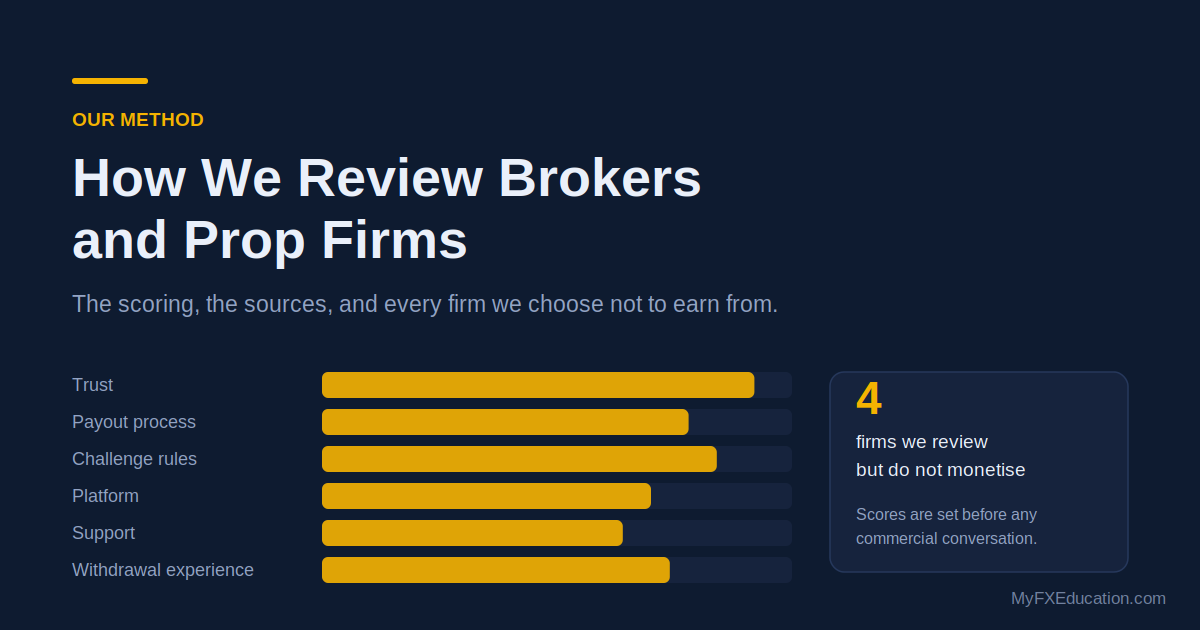
Scores are set before any commercial conversation. The research happens, the review is written, the score is set. Only then does the question of whether a link exists arise. No firm can buy a score, a placement, or a change to published copy. No firm sees a review before it is published.
We disclose regulatory and platform-review flags in the review itself, rather than withholding a link over them. As of September 2026, four firms we cover carry a flag worth knowing about:
- E8 Markets and Alpha Capital Group, whose Trustpilot ratings are currently suppressed for a breach of Trustpilot’s guidelines.
- VT Markets and PU Prime, both of which appear on the FCA’s warning list of firms operating without UK authorisation.
Each review states the flag plainly, near the top of the page, and we carry a standard affiliate link on all four, the same as on any other review. Two things shape that approach. First, an FCA warning-list entry is a notice that a firm is not authorised in the UK; it is not a fine, a finding of wrongdoing or an enforcement action, and we do not present it as one. Second, in going back through the negative reviews behind these flags, a significant share trace to traders caught hedging, exploiting low-liquidity conditions, or otherwise breaching the terms they agreed to — not to the firm failing to do what it said it would do. We still read every complaint on its own merits, and we report the ones that hold up.
Where a review is not monetised, the review says so on the page. That is deliberate and slightly awkward for us: it means we cannot quietly add a link later, because the published text would then be a lie. Changing the commercial arrangement requires changing the copy first, in public.
Some programmes pay more when a reader deposits more. Tiered commissions are common, and a larger first deposit can be worth several times a smaller one to us. We do not let that shape what we tell you to deposit, and our risk lessons will keep telling you to start small.
Where We Do Not Promote
Visitors in the United States see education only. We do not promote brokers or prop firms to readers there, and affiliate links are geo-blocked rather than merely disclaimed. This is a deliberate compliance choice about unregistered introducing-broker risk, and it costs us the single largest market for this content.
Individual programmes also exclude particular countries under their own licensing. Where a firm cannot lawfully accept a reader from their country, the review says so rather than sending them to a dead end.
Corrections And Right Of Reply
We get things wrong. When we do, we fix the page and leave a dated note on it saying what changed. We do not quietly edit and pretend the earlier version did not exist.
We have already applied this to ourselves. A payout-backlog figure we had been carrying about one firm did not survive a source check in September 2026, so we removed it rather than publish it with a hedge.
If you believe something on this site is inaccurate, tell us through the contact page and point at the specific claim. That applies to readers and to the firms we write about equally. Any firm named on this site can put its response on the record and we will publish it in full alongside our own reporting.
Who Writes This
Reviews and research on MyFXEducation are published under the byline Matthew Starmos.
The work is documentary rather than anecdotal: reading brokers’ and prop firms’ own terms and rulebooks, checking company registrations and regulator registers directly, and putting a date on every claim so readers can check it for themselves. Where something cannot be verified, the review says so.
How Our Education Content Is Structured
MyFXEducation also publishes structured trading education through our online learning portal.
Our educational content may include lessons, quizzes, checklists, course modules and learning paths for beginner and developing traders. Course content is designed to support practical understanding of trading concepts such as leverage, margin, risk management, broker selection, prop firm rules and trading platforms.
Some education content may be freely available, while other resources may require account registration. Login-based education allows learners to track progress, complete quizzes and access structured learning paths.
Our education content is for general information only. It does not provide personal trading advice, investment advice or guaranteed trading outcomes.
Important Risk Warning
Trading forex, CFDs, derivatives and other leveraged products involves significant risk. You can lose money quickly, especially when using leverage.
Prop firm challenges also involve risk. Challenge fees can be lost if account rules are breached, profit targets are not met, or trading conditions are misunderstood.
EAs, indicators and signal tools do not guarantee profits. Past performance, backtests and advertised results do not guarantee future performance.
MyFXEducation provides educational and review content only. Nothing on this website should be treated as personal advice, investment advice or a guarantee of trading results.
Always do your own research and only trade with money you can afford to lose.